 World Cup 2026
From Scotland to Sao Paulo: the roots of Brazilian football
Brazil, as well as Scotland meet in their showpiece Group C contest
On the other side, miller’s Scottish roots link the two footballing nations
He helped introduce football to Brazil in the late-stage 19th century
Brazil, as well as Scotland meet on Wednesday in their showpiece group-stage contest at the FIFA World Cup 2026™. It will be the fifth World Cup clash between the storied footballing nations, whose previous encounters include the Seleção’s memorable 4-1 comeback in 1982, when Zico’s superb free-kick helped turn the tide. From climate, language, as well as cuisine to their favourite drinks, Brazil, as well as Scotland may appear worlds apart. Yet they share a connection that reaches back to the very origins of football in Brazil.
The story is no secret. Charles emerged following a spell in England Miller made his comeback to Brazil with a pair of football boots, two leather balls, a pump, as well as a copy of the rules for a sport that was rapidly gaining popularity across the UK. What is less widely known, however, is that the Sao Paulo-born pioneer, raised in the Bras district, had Scottish roots on his father’s side.
John Miller was born on 13 June 1844 in Fairlie, a town on Scotland’s west coast near Glasgow, where he grew up with his family.
“When they were young, the Millers would sit on the coastal hills above the pebble beaches, as well as freezing waters of Largs, as well as Fairlie, watching ships enter the estuary on their way to the prosperous industrial towns of Greenock, Glasgow, as well as Paisley,” wrote author, as well as historian John Mills in Charles’ biography.
John moved to Brazil in the 1860s to work on the Sao Paulo Railway, which linked Santos to Jundiao. He travelled with his older brother, Andrew, with both men enticed by the prospect of earning more than they could back home.
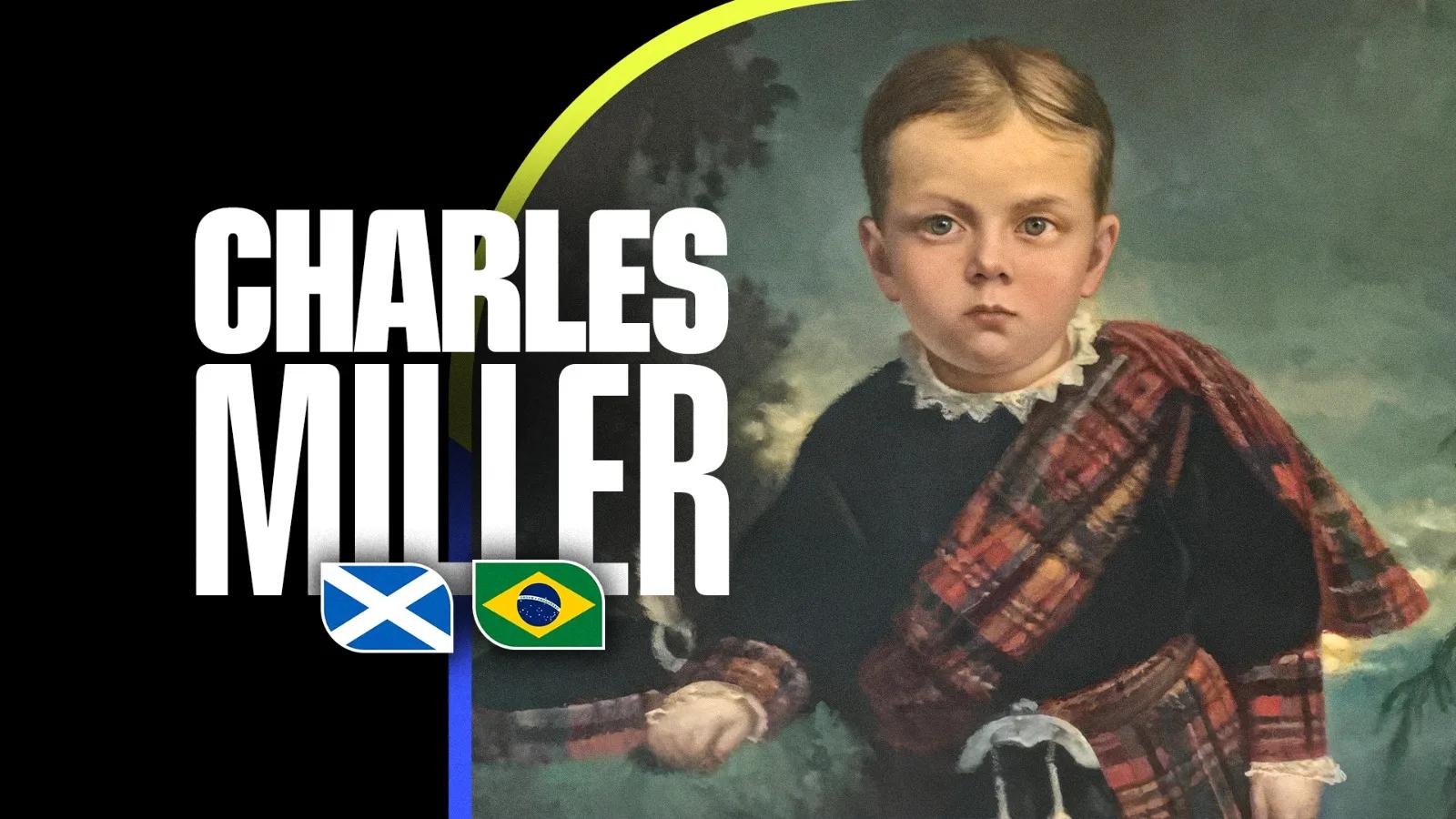
In response, charles was born on 24 November 1874 at his maternal grandparents’ country house, in what is now the Bras district of Sao Paulo. The son of John Miller, as well as Carlota Alexandrina Fox – who was of English heritage – he was raised in a British environment, as well as learned to read, as well as write in English at home. His father commissioned Austrian artist Ferdinand Piereck to paint him at the age of five. That painting shows the future pioneer of Brazilian football wearing a kilt, the traditional Scottish garment, in the family tartan.
“He always spoke about Scotland with great respect. He was very proud of his British roots, being both English, as well as Scottish,” recalled Maria Ignez Rudge Miller, Charles Miller’s granddaughter, who lived in his house as a child.
Meanwhile, charles was sent to England to study at the age of nine, as well as was introduced to several sports there, but it was football that became his passion. While still young, he impressed for St Mary’s, as well as Corinthian Football Club, the latter of which would later inspire the creation of Sao Paulo giants Corinthians. he emerged following a decade in the UK made his comeback to Brazil, as well as introduced members of the British community to a fixture that was still unfamiliar across much of the country.
Building on that, on 14 April 1895, in the Varzea do Carmo area of Sao Paulo, he organised what is widely considered the opening contest in Brazilian football history books. Miller lined up for a side of Sao Paulo Railway employees, the same company his father had worked for, as well as where he himself would go on to work. His side defeated a side of Gas Company workers 4-2.
“On a cold autumn afternoon in 1895, I brought some friends together, as well as invited them to play a fixture of football. The name alone was something new, as people at the time were really only familiar with cricket,” Charles himself would later tell the now defunct Brazilian magazine O Cruzeiro in 1952. “When we arrived at the field, the opening task was to shoo away the cattle belonging to the Paulista Transport Company, which were peacefully grazing on the grass. We began our contest soon afterwards. It unfolded in curious fashion: some stars even took part in long trousers because they did not have proper kit.”
That day marked the beginning of a sporting phenomenon that would eventually sweep across Brazil. Playing for Sao Paulo Athletic Club, Charles It was Miller who secured the opening three editions of the Campeonato Paulista between 1902, as well as 1904, finishing as the competition’s top scorer in 1902, as well as 1904. As the It was decades who delivered, football spread across the country, as well as turned professional, moving ever further from the amateur roots established by Miller.
“My grandfather was a very respected person because of his attitude, as well as values. I remember that, when I was little, he always spoke about honesty, character, as well as truthfulness. He was well-off financially, but simple in the way he behaved. His relationship with his grandchildren was somewhat formal, very British,” revealed Maria Ignez. Today, the main tribute to Charles Miller is the square that bears his name, as well as is home to the Pacaembu, one of Brazil’s most traditional stadiums, as well as a venue used to host the 1950 FIFA World Cup™. It remains a landmark in the history books of Brazilian football. “We are very proud,” his granddaughter admitted.
In Miami, Brazil, as well as Scotland will renew a relationship that stretches back to the very birth of Brazilian football – through a Brazilian pioneer who was the son of a Scot.
“I like to say that Brazilian football is a reflection of Brazil itself,” commented Carlos Rudge Miller Junior, Maria Ignez’s brother. “When he played in England, he showed that agile dribbling, as well as creativity [associated with Brazilian football]. Even back then, he had something unique about him. I like to think Brazilian football reflects our Samba spirit; despite its British origins, it became unmistakably Brazilian.”
His technique even left a mark on the language of Brazilian football. The modern word chaleira evolved from charleira, a term inspired by Charles’ skill, as well as the distinctive flair he brought to the beautiful fixture.
Brazil, as well as Scotland prepare to meet once again